

Service charges

Grounds maintenance operative talking to customer

What are service charges?

Service charges are payments that help cover the cost of maintaining shared areas and facilities in your building or estate. These charges ensure that communal spaces remain safe, clean, and well-maintained for everyone’s benefit.
What do service charges cover?

The services included in your service charge depend on your property type and location. Common services include:

Cleaning and caretaking

keeping communal areas, such as hallways, staircases and pathways, clean and well-maintained.

Grounds maintenance

maintaining communal gardens including grass cutting, strimming, hedge cutting, maintenance of shrubs/borders, clearing hard standings, disposal and management of household and bulk waste.

Communal utilities

cost of running communal electricity e.g. internal and external lighting, running lifts, emergency lights and fire alarms. For sheltered schemes also includes costs of communal gas and water.

Communal repairs and maintenance

electrical and fire safety testing, communal lift maintenance, legionella testing, repairs and maintenance carried out on communal areas.

Door entry

servicing, repairing and replacement of the door entry system or appliances, including keys, key card, keypad door locking mechanisms and door entry phones or intercoms.

Building insurance & management fees

covering administrative costs related to managing your building and its services.

Estate services

maintaining community and shared outdoor spaces, such as grass cutting and tree maintenance in public areas.

Pest control

where applicable, dealing with infestations in communal areas.

Not all services apply to every property. Your service charge breakdown will outline which ones are relevant to you.

How are service charges calculated?

Charges are calculated based on the actual cost of providing services. Costs are typically split among residents using methods such as:

  • Equal division among homes in a building or estate.
  • the terms of your lease or tenancy agreement

Each year, estimated costs are set, and at the end of the year, actual costs are reviewed. If actual costs exceed estimates, you may need to pay the difference. If they are lower, you may receive a refund or credit.

Your service charge depends on where your home is within the structure below: This ensures you only pay for the services that you benefit from.

Property level

individual home expenses, such as building insurance.

Block level

shared costs within your building, such as lift maintenance, communal gardens and security such as CCTV.

Estate level

charges for wider estate services, like public open spaces.

Area level

regional services, such as management fees.

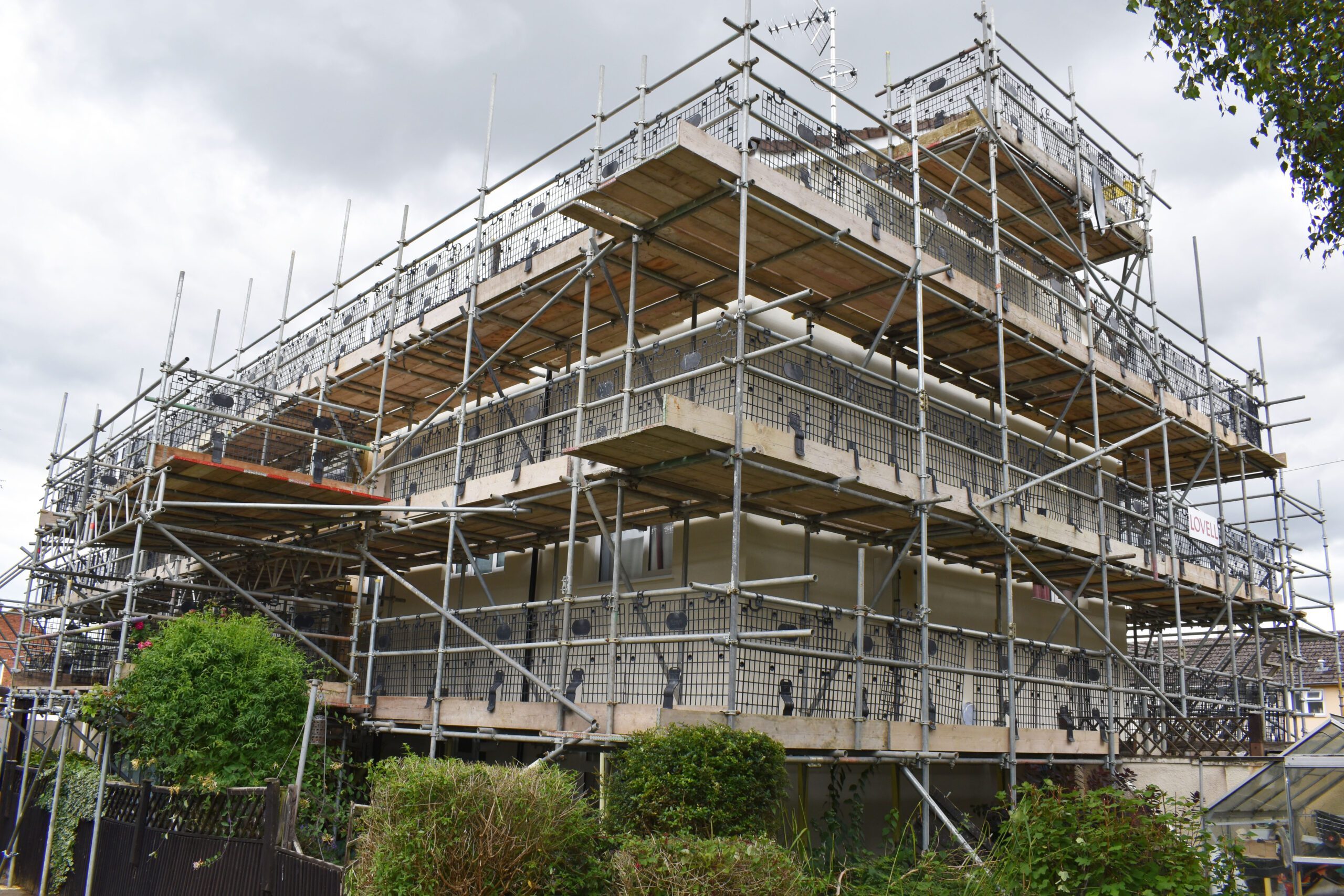
scaffolding around a block of flats

Leaseholders and Shared Owners

Leaseholders and Shared Owners may see a separate charge towards a reserve (or sinking) fund. This fund is used to cover large future expenses, such as roof repairs or lift replacements. This helps avoid large unexpected bills when major works are needed.

For major works, landlords must consult residents under Section 20 of the Landlord and Tenant Act 1985 if costs exceed a set threshold or for service contracts such as buildings insurance or utilities where the cost will exceed £100 in that financial year. This process ensures transparency and gives residents a say in significant expenses.
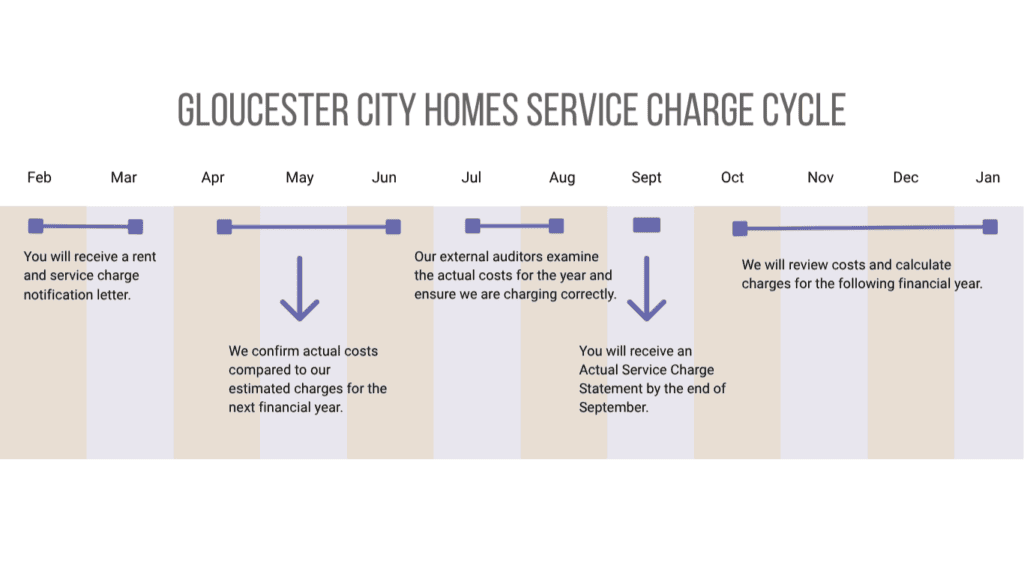

Service Charge Cycle

We follow a service charge cycle to help keep you informed and ensure charges are accurate and fair:

  • February/March
    You will receive a rent and service charge notification letter at the end of February or start of March. This includes a breakdown of estimated service charge costs for the upcoming financial year. The financial year runs from April to March.
  • April-June
    During this time, we confirm actual costs compared to our estimates and prepare estimated charges for the next financial year. No action is required from you during this period.
  • July – August
    During this time our external auditors examine the actual costs for the year and ensure we are charging correctly for the services provided, including checking samples of invoices for works and services, management fee calculations and apportionment of costs.
  • September
    You will receive an Actual Service Charge Statement by the end of September. This shows how the estimated costs compare to the actual costs for the previous financial year. 
  • October – January
    During this time we will be reviewing costs and calculating estimated charges for the following financial year.

Gloucester City Homes service cycle chart. Information on the chart includes: Jan - Mar. You will receive a rent and service charge notification letter. Apr - Jun. We confirm actual costs compared to our estimated charges for the next financial year. Jul - Aug. Our external auditors examine the actual costs for the year and ensure we are charging correctly. Sept. You will receive an Actual Service Charge Statement by the end of September. Oct - Jan. We will review costs and calculate charges for the following financial year.

Your rights and how to manage your charges

If you think you are being charged incorrectly or for services not received:

  • Check your statements – review your service charge breakdown carefully.
  • Respond to consultations – provide written responses to consultation letters.
  • Contact us – if something doesn’t look right, get in touch with our team to discuss it.
  • Request more information – you can ask for further details about any service charge items.
  • Raise a formal dispute – if concerns remain unresolved, you may follow a formal complaints process or seek independent advice.

What if I struggle to pay?

We understand that service charges can be an extra financial burden. If you’re struggling to pay:

  • Talk to us – we may be able to set up a payment plan or provide financial guidance. Visit our tenancy sustainment page for more information.
  • Seek support – external organisations, such as Citizens Advice, may offer help.
  • Check for benefits – you might be eligible for financial assistance.

For further information or specific queries about your service charges, please contact us at service.charges@gch.co.uk